
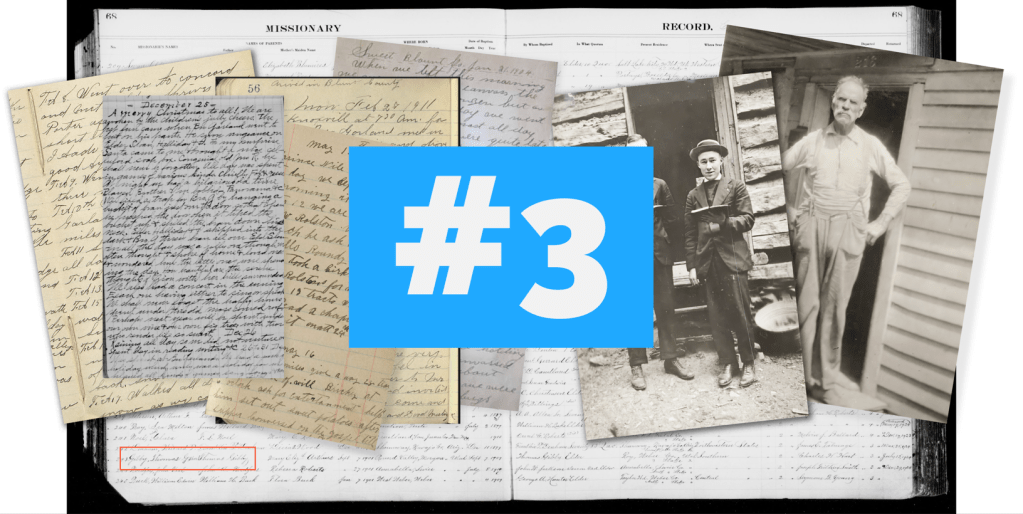
1. Missionaries are quick to learn the importance of obedience as they learn to rely on the guidance of the Holy Ghost. As such, they learn that a lack of obedience can also drive the Spirit away. Likewise, blessings are predicated upon obedience. “There is a law, irrevocably decreed in heaven before the foundations of this world, upon which all blessings are predicated—And when we obtain any blessing from God, it is by obedience to that law upon which [that blessing] is predicated” (D&C 130:20–21). What happened when Elder Isaac Smith did not immediately follow the counsel from his Conference President to come to Blount County?
Find answer in Elder Smith’s journal
See October 28, 1897
Find answer in dropdown
Thursday – 28 October 1897 Previous to today we had received a letter from President [James Ellingham] Hart inviting us to go to Blaunt Co[unty] (sic) to meet Elders [Frederick Gilbert] Warnick and [Joseph Rowland] Morrell and help them hold conference with the Saints, but we thought we were too busy. We didn’t like to break into our week’s work, and so continued our work this morning visiting families and holding meetings with them. On walking up to a Mr. Lutteral’s house, Elder [Adams Wesley] Ensign knocked and the door came open. He started to tell our business but was interrupted by, “Well you can’t come in here! I don’t want anything to do with such trash!! Get right out of here, the sooner the better. Your absence is better than you’re (sic) a-a-a-absence!” We wondered, for a moment what to do, but he was so mad there was no use trying to reason with him. “Hurry up,” he continued, still abusing us. We walked out slowly (he still urging us to hurry). When we got out in the road, he commanded us to go down the road and not up. We thought this was a little too much, so Elder [Adams Wesley] Ensign answered him in rather an independent way, “Well, I guess this is public property,” but he soon gave us to understand it belonged to him. Then, Elder [Adams Wesley] Ensign asked whose land that was on the other side of the road, and he told us it belonged to Mr. McMullen. Well, we told him we would get over the fence and go up through the field then. This brought the fire out of his eyes. He rushed in the house and it sounded like he was falling over every chair. We knew what he was after, so we started to walk down the road. He came out with a single barrel shotgun (this convinced us we were doing right by walking down the road), pulled the hammer up and raised the b[arrel]. Seeing we were so submissive (I suppose), he took the compassion on us. Nevertheless, he didn’t shoot. We concluded that this was a good strong hint that we were not doing our duty by not complying with the letter from President [James Ellingham] Hart and right there and then prepared to go. We walked to Knoxville that night, 11 mi[les] and had 27 mi[les] before us the next day.
2. Doris Russell wrote a short life history in her later years. She recalled the important role the missionaries played in her life, even as a little girl. Who did Doris Russell name her kittens after and what were their three names?
Find answer in FamilySearch
See the top of page 3 of 10
Find answer in dropdown
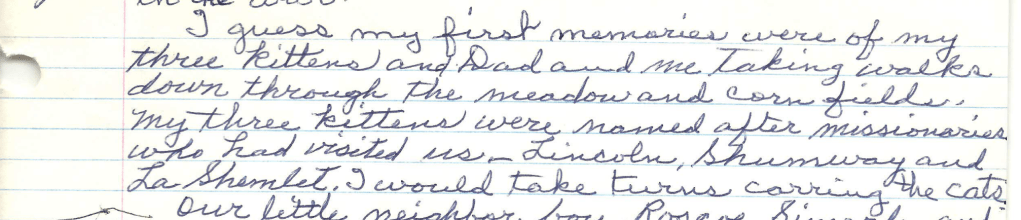
“I guess my first memories were of my three kittens and Dad and me taking walks down through the meadow and corn fields. My three kittens were named after missionaries who had visited us: Lincoln; Shumway; and La Shemlet. I would take turns carrying the cats…”
See photo in dropdown
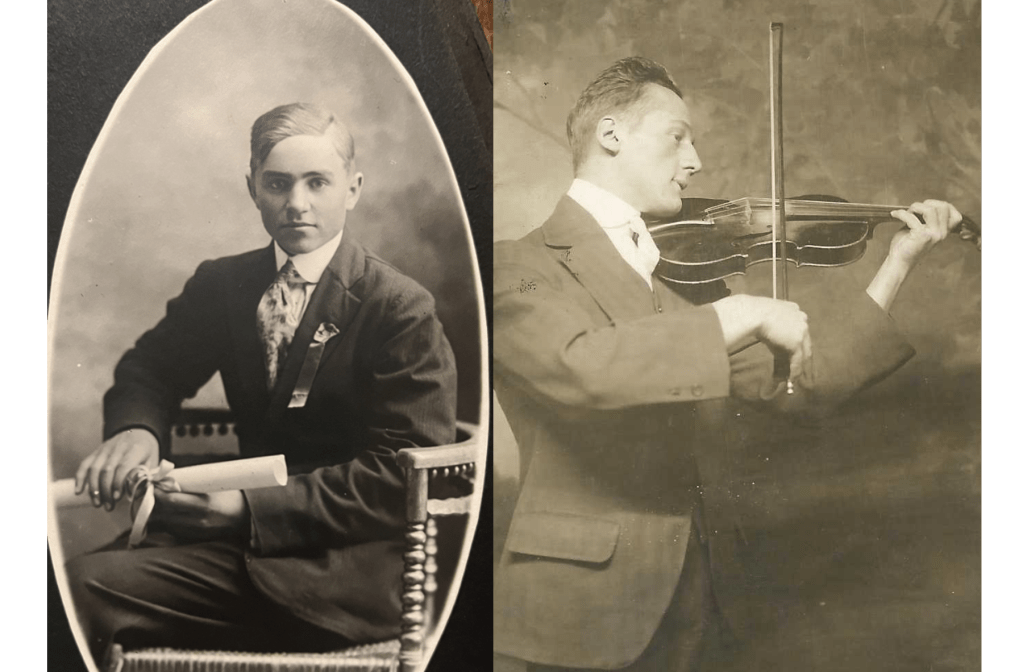
Two of the three kittens likely were named after Elder Quentin Shumway and Elder Edmond LeCheminant
3. Elder Neil L. Anderson said, “Embrace your sacred memories. Believe them. Write them down. Share them with your family. Trust that they come to you from your Heavenly Father and His Beloved Son. Let them bring patience to your doubts and understanding to your difficulties.” Doris Russell shared her last sacred memory of her father. It is a testimony of her faith and her father’s faith that this is the restored gospel of Jesus Christ. Who did Charles Russell see the day before he died on Christmas Day 1919, and what did his daughter say about his testimony?
Find answer in FamilySearch
See page 9 of 10
Find answer in dropdown
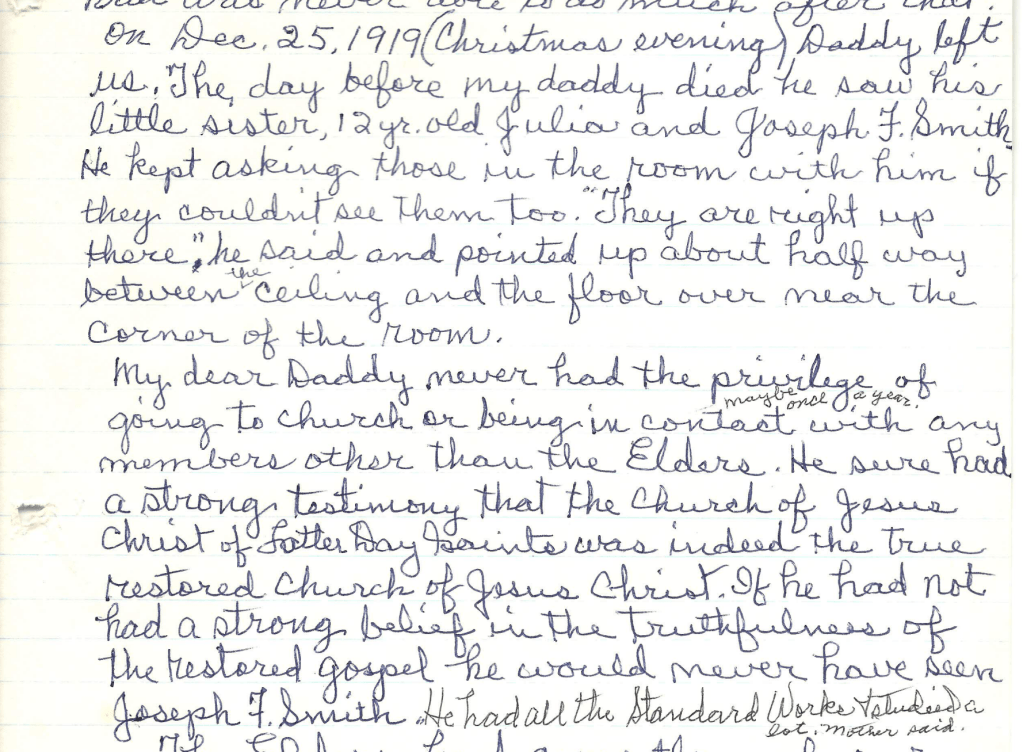
“On Dec[ember] 25, 1919 (Christmas evening) Daddy left us. The day before my daddy died, he saw his little sister, 12-y[ear]-old Julia, and Joseph F. Smith. He kept asking those in the room with him if they couldn’t see them too. “They are right up there,” he said, and pointed up about halfway between the ceiling and the floor over near the corner of the room.
My dear daddy never had the privilege of going to church or being in contact, maybe once a year, with any members other than the elders. He sure had a strong testimony that The Church of Jesus Christ of Latter-day Saints was indeed the true Restored Church of Jesus Christ. If he had not had a strong belief in the truthfulness of the restored gospel, he would never have seen Joseph F. Smith. He had all the Standard Works and studied a lot, Mother said.”
4. According to Doris Russell, why did it take her mother longer to be baptized than her father?
Find answer in FamilySearch
See bottom of page 9 of 10
Find answer in dropdown
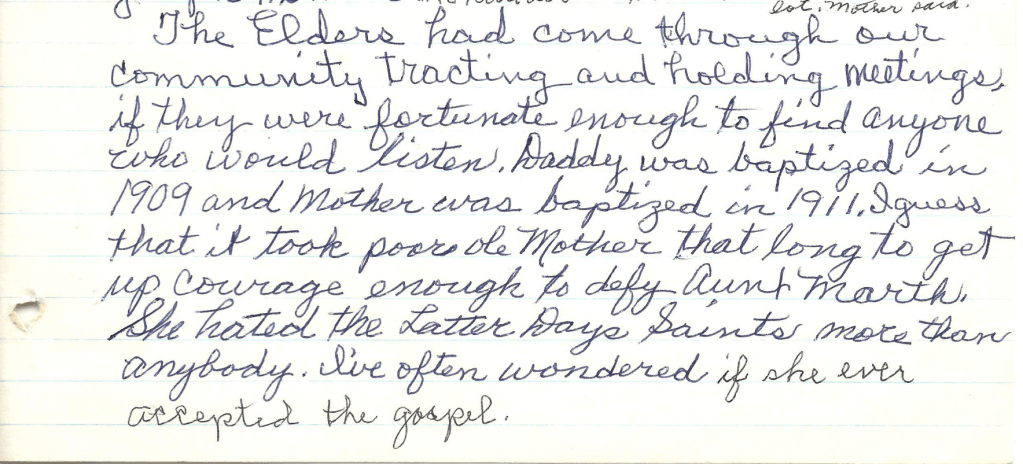
“The elders had come through our community tracting and holding meetings, if they were fortunate enough to find anyone who would listen. Daddy was baptized in 1909 and Mother was baptized in 1911. I guess that it took poor ‘ole Mother that long to get up courage enough to defy Aunt Marth. She hated the Latter-day Saints more than anybody. I’ve often wondered if she ever accepted the gospel.”
“Let us have the courage to defy the consensus, the courage to stand for principle. Courage, not compromise, brings the smile of God’s approval. Courage becomes a living and an attractive virtue when it is regarded not only as a willingness to die manfully, but also as a determination to live decently. A moral coward is one who is afraid to do what he thinks is right because others will disapprove or laugh. Remember that all men have their fears, but those who face their fears with dignity have courage as well.” -President Thomas S. Monson
5. Following his mission, Elder William Hayes became a Utah State Senator and was well known for his positive attitude and eloquent writing. In his mission journal, he had a special way of simply and positively describing his experiences. Elder Hayes baptized Samuel Harmon in Millers Cove, on April 7, 1895. He described a regular week in the life of a missionary leading up to this baptism. How would you compare and contrast the life of a missionary in 1895 to now?
Find answer in FamilySearch
Find answer in dropdown
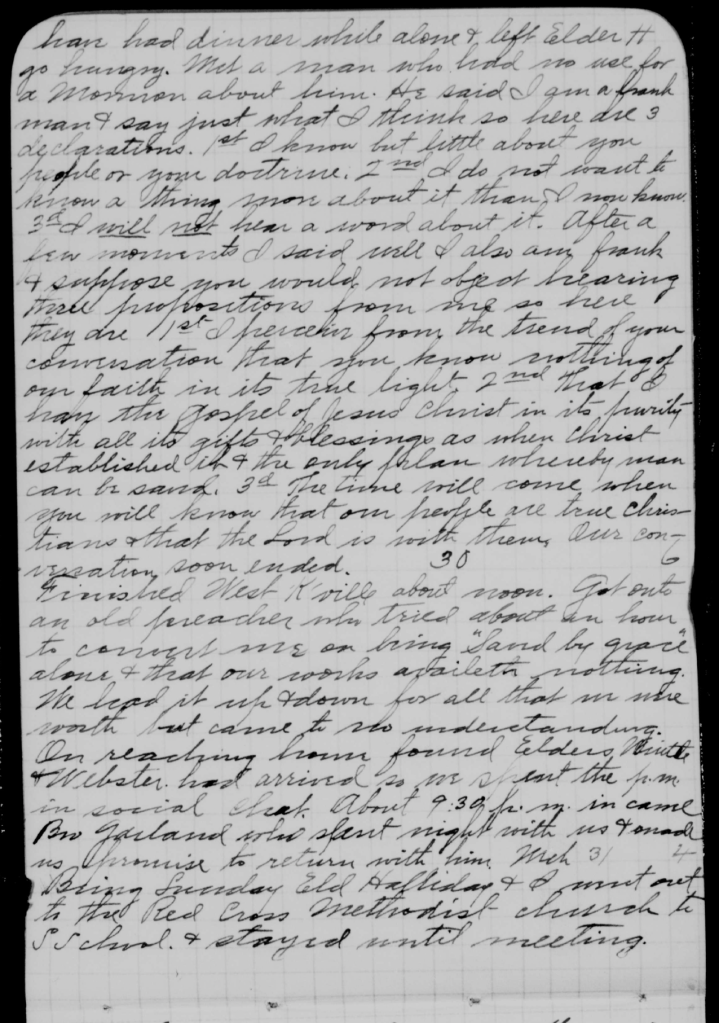
[Saturday] – 30 March [1895] Finished West K[nox]ville [at] about noon. Got onto an old preacher who tried about an hour to convert me on being “saved by grace” alone and that our works availeth nothing. We lead it up and down for all that we were worth but came to no understanding. On reaching home, [we] found Elders [George Barlow] Wintle and [John William] Webster had arrived, so we spent the PM in social chat. [At] about 9:30 PM, in came Bro[ther Joseph John Calvin (JC)] Garland who spent the night with us and made us promise to return with him.
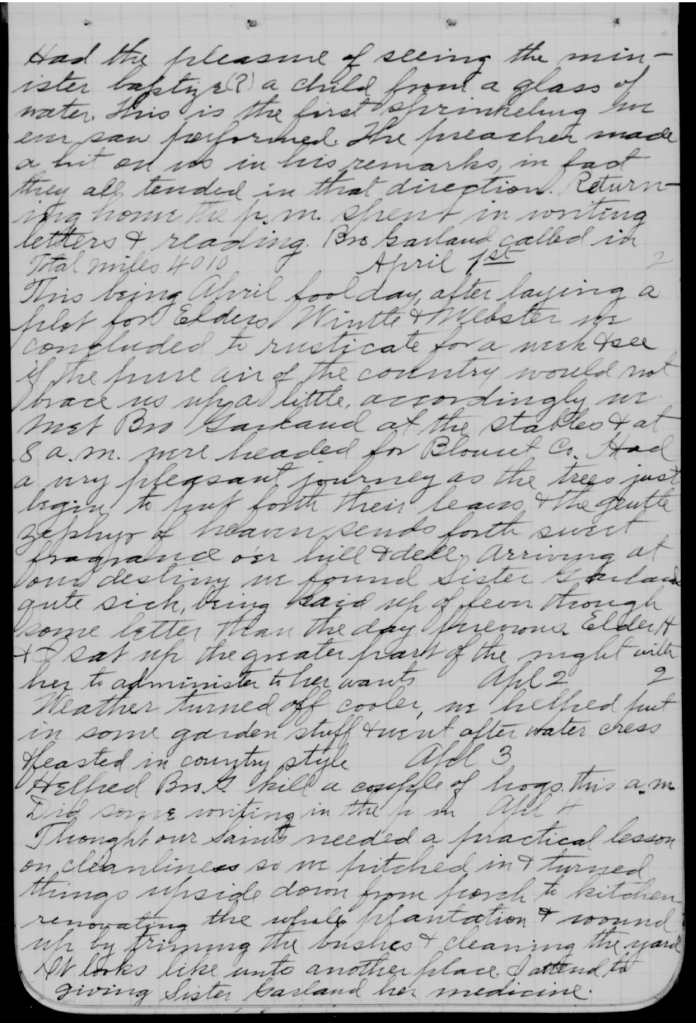
[Sunday] – 31 March [1895] Being Sunday, Eld[er John Roland] Halliday and I went out to the Red Cross Methodist Church to S[unday] S[chool] and stayed until [the] meeting. [We] had the pleasure of seeing the minister baptize a child from a glass of water. This is the first sprinkling we ever saw performed. The preacher made a hit on us in his remarks, in fact, they all tended in that direction. Returning home [in] the PM, [we] spent [it] in writing letters and reading. Bro[ther Joseph John Calvin (JC)] Garland called in. Total miles 4,010
[Monday] – 1 April [1895] This being April fool day, after laying a plot for Elders [George Barlow] Wintle and [John William] Webster, we concluded to rusticate for a week and see if the house air of the country would not [em]brace us why a little. Accordingly, we met Bro[ther Joseph John Calvin (JC)] Garland at the stables, and, at 8 AM, [we] were headed for Blount Co[unty]. [We] had a very pleasant journey as the trees just begin to put forth their leaves and the gentle zephyrs of heaven sends forth sweet fragrance over hill and dell. Arriving at our destiny, we found Sister [Sarah Margaret Cauble] Garland quite sick, being laid up of fever, though some better than the day before now. Elder [John Roland] H[alliday] and I sat up the greater part of the night with her to administer to her wants.
[Tuesday] – 2 April [1895] Weather turned off cooler, we helped put in some garden stuff and went after water cress and feaster in country style.
[Wednesday] – 3 April [1895] [We] helped Brother [Joseph John Calvin (JC)] G[arland] kill a couple of hogs this AM. Did some writing in the PM.
[Thursday] – 4 April [1895] [We] thought our Saints needed a practical lesson on cleanliness, so we pitched in and turned things upside down from porch to kitchen, renovating the whole plantation, and wound up by trimming the bushes and cleaning the yard. It looks like unto another place. I intend to giving Sister [Sarah Margaret Cauble] Garland her medicine.
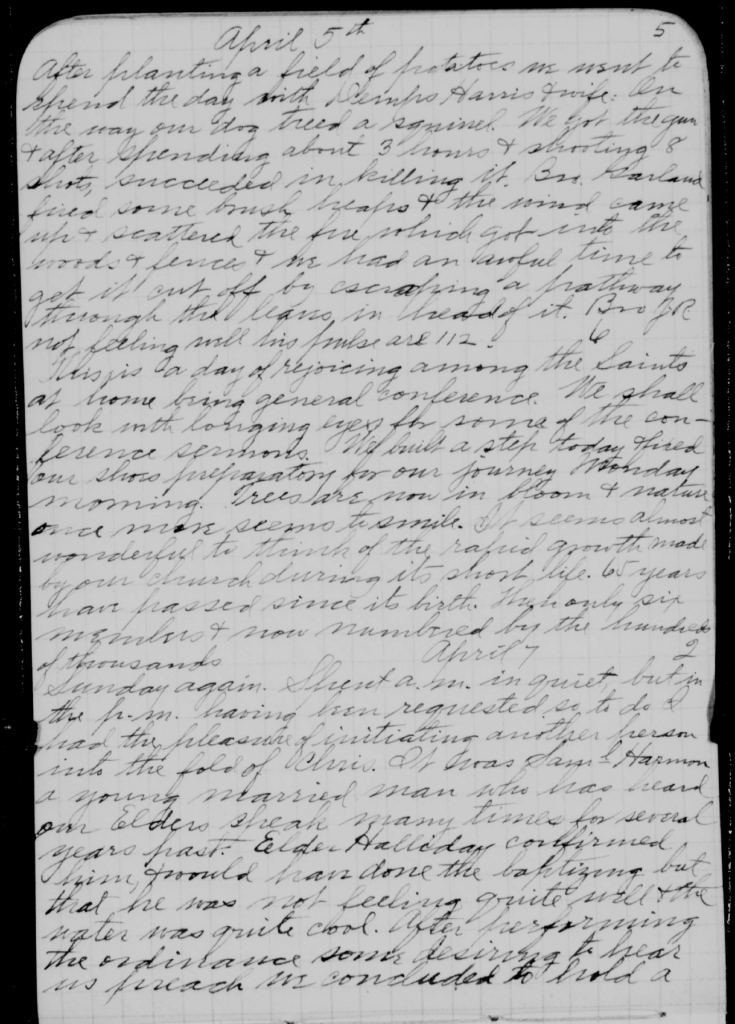
[Friday] – 5 April [1895] After planting a field of potatoes, we went to spend the day with [Nathan] Dempsey Harris and [his] wife, [Sarah Margaret Woody]. On our way, our dog treed a squirrel. We got the gun and, after spending about 3 hours and shooting 8 shots, succeeded in killing it. Bro[ther Joseph John Calvin (JC)] Garland fired some brush heaps and the wind came up and scattered the fire which got into the woods and fences, and we had an awful time to get it cut off by creating a pathway through the leaves in head of it. Brother J[ohn] R[oland Halliday is] not feeling well. His pulses (sic) are 112.
[Saturday] – 6 April [1895] This is a day of rejoicing among the Saints as home brings general conference. We shall look with longing even for some of the conference sermons. We built a step today. Hired our shoes preparatory for our journey Monday morning. Trees are now in bloom and nature once more seems to smile. It seems almost wonderful to think of the rapid growth made by our Church during its short life. 65 years have passed since its birth. Then only six members and now numbered by the hundreds of thousands.
[Sunday] – 7 April [1895] Sunday again. [We] spent [the] AM in quiet, but in the PM, having been requested so to do, I had the pleasure of initiating another person into the fold of Christ. It was Samuel [Patterson] Harmon, a young married man who has heard our elders speak many times for several years past. Elder [John Roland] Halliday confirmed him and would have done the baptizing but that he was not feeling quite well and the water was quite cool. After performing the ordinance, [with] some desiring to hear us preach, we concluded to hold a short service on the porch of Bro[ther Joseph John Calvin (JC)] Garland‘s house, which we did. Sister [Sarah Margaret Cauble] G[arland] is some better than she has been though unable to sit up as yet. I wrote to the Saints on the Pigeon River from who[m] I received letters some weeks ago. They are very anxious to have us make them a visit in the near future, which we will try to do, where we hope to do some more baptizing, thus adding to our flock.
6. The brother of the founder of BYU Idaho, formerly Ricks College, served in Blount County in 1893. What is his name and how many children did he have when he left for his mission in Tennessee?
Find answer in missionary biographies
Clue: Thomas E. Ricks is the founder of Ricks College
Find answer in dropdown

William Ricks (1839-1900) served in the Southern States Mission from 1893 to 1894. In his mission acceptance letter to George Reynolds, he wrote: “I am pleased to answer you in the affirmative.” He was nine years old when he traveled by wagon with the pioneers from Nauvoo to Utah in the Heber C. Kimball Company. At age 24, he returned to assist another group of pioneers traveling by wagon to Utah. He served as a Minute Man to defend the early pioneers against the indians. He returned to Wyoming multiple times to rescue pioneers needing assistance and suffered from exposure to the elements during these ventures. His ongoing physical ailments from this exposure are documented during his mission in the 1893 journal of his companion, Robert Young. William Ricks married early pioneer, Margaret Gordon, in 1865. When he was called to serve in East Tennessee, he and Margaret had 12 children, 10 would live to adulthood. His brother, Thomas E. Ricks, founded Ricks College, now known as BYU Idaho. Martin Harris, one of the transcribers of the Book of Mormon and one of The Three Witnesses of the gold plates, was William Ricks’ neighbor in Clarkston, Utah. He entered a second marriage with Mary Clark, with whom he had one child. He served nine months in the East Tennessee Conference and was forced to return home due to his health. William Ricks died six years after his mission “directly related to his exposure to extreme weather on his many trips to help his fellow saints.” At the time of William Ricks’ wife’s death, they had 138 living descendants. A record of his short time in Blount County is found in the transcribed mission journal of Elder Robert Young. Elder Ricks confirmed Alexander Harrison Garland and Joseph John Calvin (JC) Garland as members of The Church of Jesus Christ of Latter-day Saints in Millers Cove, in 1893.
7. By 1939, there were 100 baptized members of the Church who had lived within the Smoky Mountain Ward boundaries. Sadly, three of them had been murdered by 1939. Statistically speaking, it could be said there was 3-percent chance of being killed as a member of the Church. Unfortunately, Will Garland was one of these members. How was Will Garland killed?
Find answer in FamilySearch
Find answer in dropdown
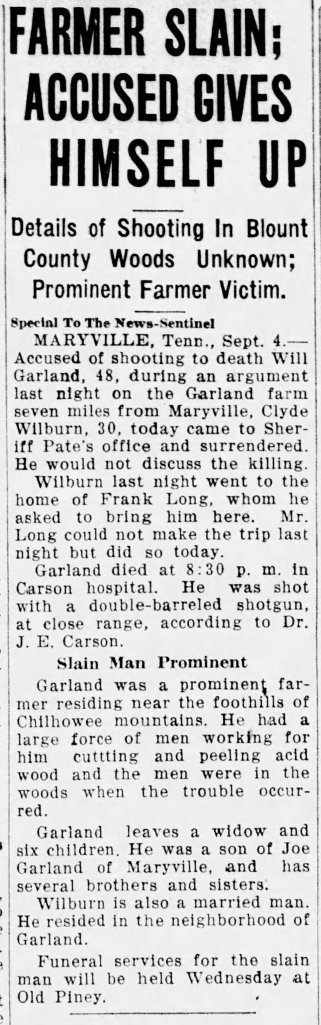
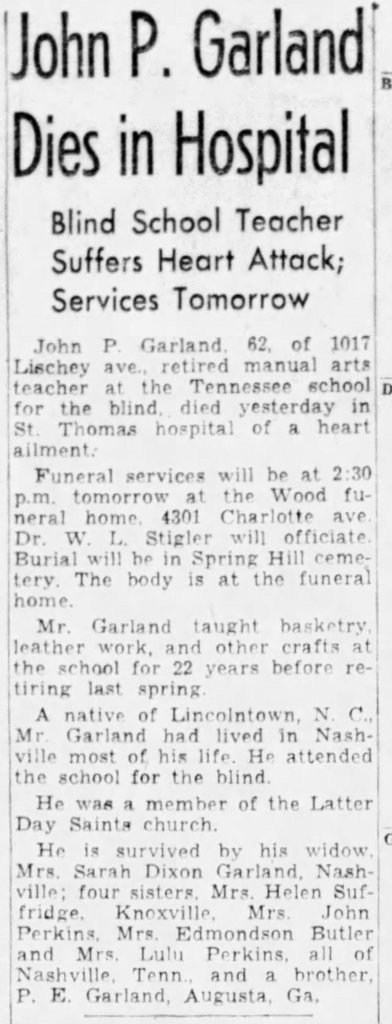
8. JP Garland was baptized in Millers Cove, in 1898, before being sent to a special school in Nashville. What special challenge did he work with throughout his life and what church does his obituary say he was a member of? What do you imagine is the first thing JP Garland saw on the other side of the veil?
Find answer in FamilySearch
Find answer in dropdown
9. This one will make your brain hurt, but you can do it! Elder Will Hunter baptized Charles Russell in Maryville in 1909. A few weeks after his baptism, Elder Hunter was photographed in Grundy County with a man named Lyman Smartt. Two years after this photo was taken, Charles Russell had a son named Leroy. In 1946, 35 years after the photograph, Leroy married a young lady named Eva Smartt. Remember, Elder Will Hunter and Lyman Smartt appeared together in a photo in 1909. So, the question is: How are Eva Smartt and Lyman Smartt related? Bonus: Why is this photograph of Elder Will Hunter and Lyman Smartt ironic? What would have happened if Elder Will Hunter did not serve a mission?
Find answer in FamilySearch
Find answer in dropdown
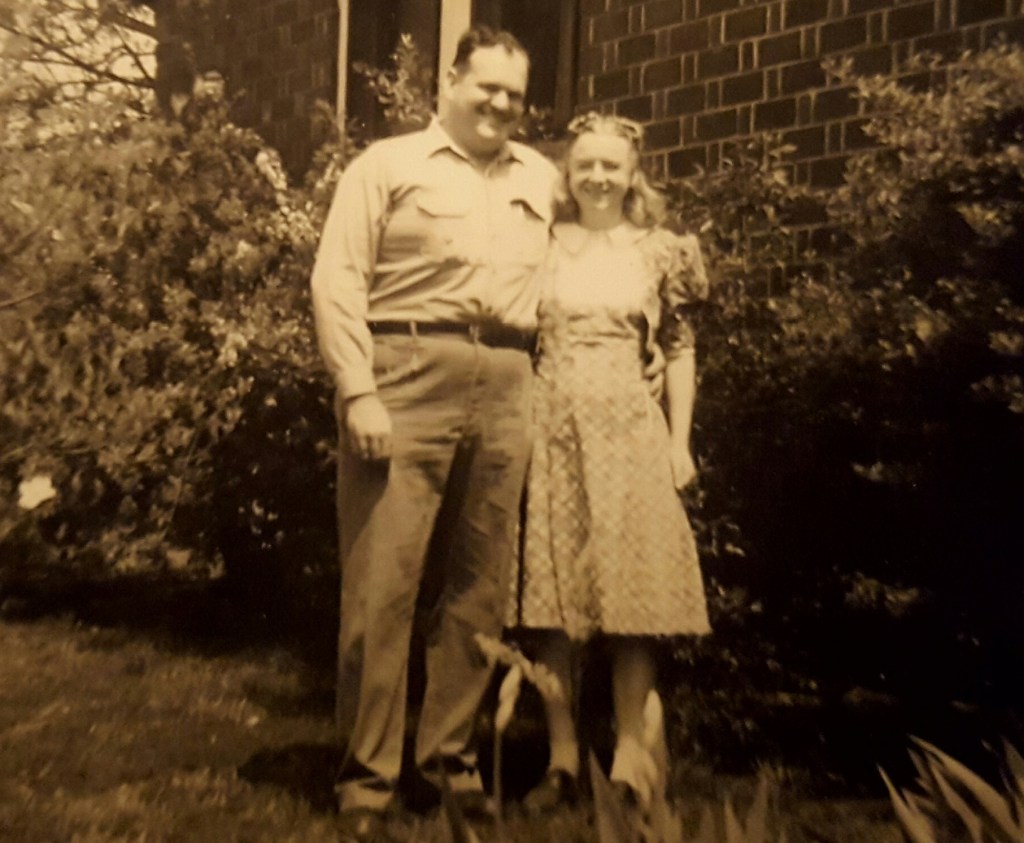
Leroy Russell and Eva Smartt were married on April 21, 1946. They traveled to Salt Lake City together and were sealed on August 16, 1948.
See photo of Lyman Smartt and Elder Hunter
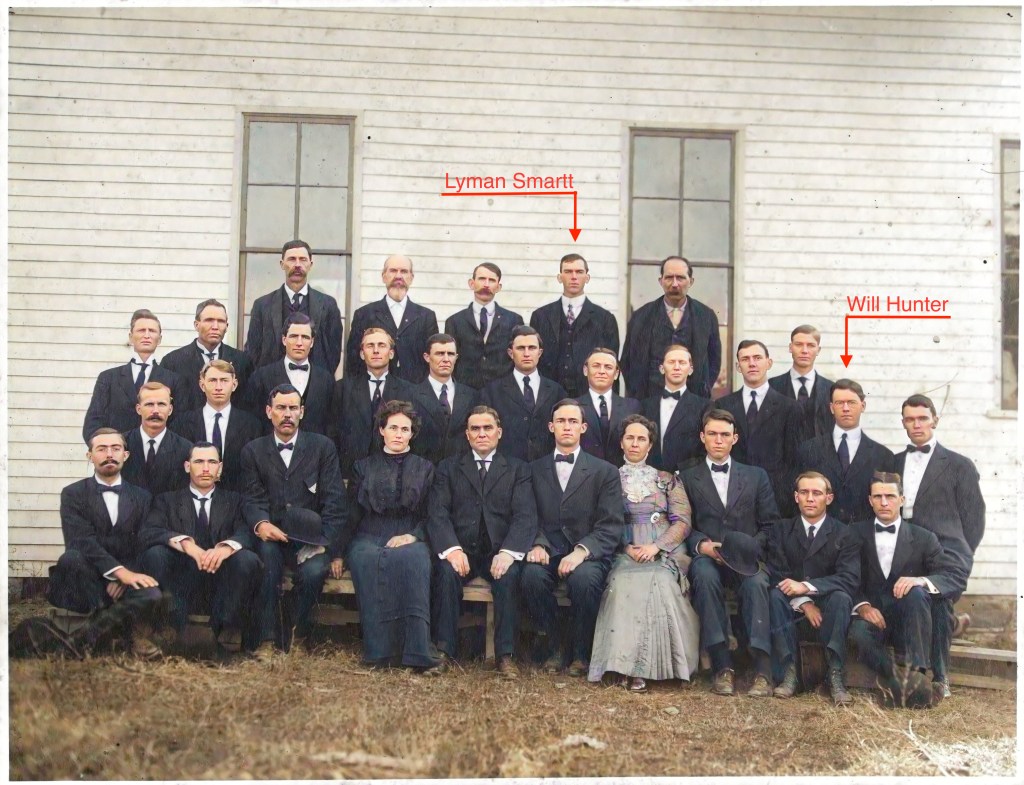
The irony: In this photo taken in 1909, Elder William Hunter is standing near Lyman Smartt whose future daughter, Eva Smartt, would marry, in 1946, the future son, Leroy Russell, of the man, Charles Russell, whom Elder William Hunter had baptized a few weeks before this photo was taken.
The 1909-photo was taken at the dedication of the Northcutts Cove Chapel in Grundy County, Tennessee, on October 24, 1909. This remains the oldest-standing chapel of The Church of Jesus Christ of Latter-day Saints in the southeastern United States. Southern States Mission President, and later member of the Quorum of the Twelve Apostles, Elder Charles A. Callis is seated in the middle next to his wife, Grace Pack. The men standing in the back row are from the Northcutts Cove Building Commission, all others are ordained missionaries of the Church. Lyman Smartt was never baptized but encouraged his family to do so and always supported them in the Church.
10. Leroy Russell was baptized in Maryville two months before his father died in 1919. He married Eva Smartt who was baptized in 1929. What top secret government program did Eva Smartt work on?
Find answer in “The Russells“
See section titled “Leroy Morley Russell (1911-1969)”
 Smoky Mountain Ward